Hello everyone! It’s time for another update from your friendly, neighborhood scientist hosting a new Collateral Science post. Today I’m posting about what I see as the biggest concern, the ability of SARS-CoV-2 to mutate. Clean your glasses, this is going to be a much deeper dive into the science around COVID-19 than before.
To make sure everyone is on the same page, I’m going to start with the very big topics of what DNA and RNA are, then work to the importance of sequences, progress to the mutations in SARS-CoV-2, and end with what is currently known about the spread of the virus and patterns of mutations this particular virus is accumulating.
So, let’s talk DNA and RNA. All living things need a way to transmit the information of what they are and how they function. To date, everything on earth uses one of two systems DNA, deoxyribonucleic acids, or RNA, ribonucleic acids. Granted, there’s a whole debate questioning if viruses technically count as alive but since that’s the focus of this post we’ll grant them that status for now. DNA usually comes as double stranded with matched base pairs that help it be a very stable means to hold information. RNA usually comes as single stranded which makes it much more vulnerable to mutations, but it can have secondary structures that add to its stability. DNA is able to be transcribed to RNA and vise versa, depending on what enzymes are present within a cell.
When a cell needs to make a protein it will transcribe a section of DNA with the necessary information into a messenger RNA, or mRNA, that is then translated into a protein that performs functions within the cell. Cells are a thriving hub of activity and the process of creating proteins is a small facet of what DNA and RNA can do, but since this is what we’re worried about for SARS-Cov-2 I’ll stop there. If you’re interested in learning more about cell function, I highly recommend checking out https://www.youtube.com/user/AmoebaSisters as they are accurate, educational, and fun to watch.
When organisms generate new copies of the DNA or RNA, it’s possible to make a mistake. This mistakes, changes from the original sequence, are known as mutations. Mutations are neither good nor bad on their own and most mutations can occur without causing any significant change to the function of an organism. There are different kinds of mutations
- Single Nucleotide Variant: A change at one base in the sequence
- Insertion: An addition (of any length) of nucleotides to the original sequence
- Deletion: A removal (of any length) of nucleotides to the original sequence
These can have further refinements depending on their effect within the cell, usually depending on how they affect a protein. One of the incredible things about the current COVID-19 outbreak is that we are able to track its mutations in real time from across the entire globe. A lot of hard working scientists are applying their expertise to sequence different specimens of the virus, so we’re able to get an unbelievably large amount of information about just how this virus is mutating on a day to day basis.
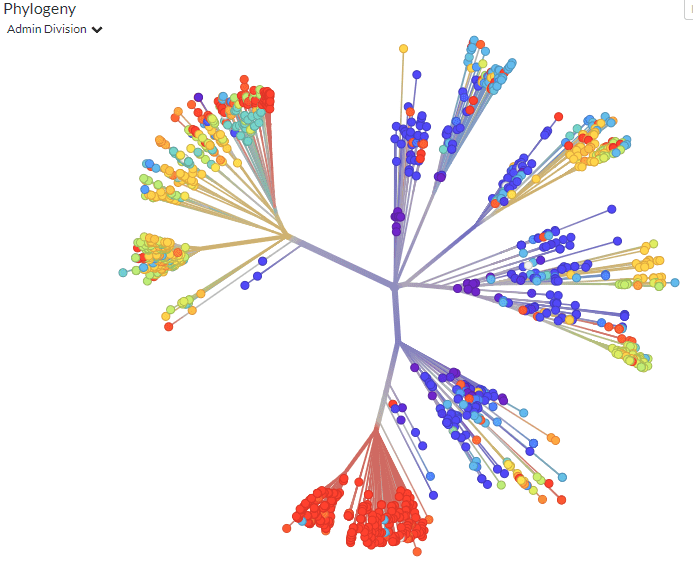
The image above traces the known SARS-CoV-2 sequences and uses their mutations to group them together as a means to show how this virus has evolved. For this style of tree, the original virus is at the middle and the distance away from the middle shows how many mutations a sample has.
The paths branch as mutations accumulate in one virus population, but not in others. This forms clusters of more highly related viruses as they share more mutations than other clusters of viruses. This particular tree is color coded for the locations the sample was taken.

From this mapping we are able to see that China, Europe, and the United States are all dominated by viruses with different sequences, but also have locations where other colors are present too. This allows us to see where the disease originated, how it has spread, and where isolated populations are occurring.
We’re able to track all of this because we can find the mutations in one sample from a COVID-19 patient and compare that to sequences from around the world in real time.
So the disease is mutating, but we expect that to happen and it isn’t anything to be alarmed about. What people are currently worried about is do the mutations being accumulated matter. I’m happy to say that this virus does not have an unusually high mutation rate, which is a good thing. We’re also seeing mutations across entire genome, which is also a good thing.

The picture above shows the length of the genome (0 to 29,000 bases) and the bars above show how many mutations have been detected at a given nucleotide. The long, color coded bars underneath represent the protein produced by that section of the virus.
Overall, we’re seeing what you would hope to see in a virus, a lot of broad, non-specific mutation locations. This means there is no particular pressure on the virus to change an aspect of its proteins rapidly. Overall, we’re looking at wonderful news for people developing treatments and vaccines. While this virus is mutating, it’s not showing anything dangerous or anything that can prevent treatments from working in the near future. The virus will continue to spread, but we’ll continue to monitor it; as the virus accumulates more isolated differences, we’ll even be able to tell where a case was from based on its unique sequence.
There is concern about the ability of this disease to reinfect someone after they recover from an initial bout of COVID-19. I am no virologist and can’t say it won’t happen in the future, but for now it looks like that isn’t possible. While there have been some reports of reinfection in people, it could be that they had false negative test results or just hadn’t quite recovered as much as they thought they had, leading people to be readmitted to the hospital. A trial performed in monkeys showed no signs of a second infection after the monkey was initially exposed, which is great news for us.
While we might feel overwhelmed with bad news right now, a deep analysis of the different SARS-CoV-2 sequences shows us that work we are currently doing to create vaccines and cures will not be interfered with. We will get through this.
Have hope,
-Colleen
 PMP in the Lab