
Howdy Everyone! Since the CDC has recommended mask wear and several areas are now mandating it, I’ve been researching what makes a good cloth mask. A marvelous paper has been released recently from Northeastern University so now seems to be the perfect time to dive into masks and how to use them.
How good are homemade masks?
There has been a lot of debate recently about the use of homemade masks and if they have any benefit or only provide a false sense of security. Past research in mask use has shown mixed results with no strong evidence that it helps or hurts. Enter Dr. Fernandez in the Civil and Environmental Engineer department at Northeastern University. Her past research was focused on microscopic pollutants and their impact on the environment. Based on her experience with particulates, she designed an process that could be used to test a variety of masks and their abilities to filter out the target particle size. After a search spreading to all corners of campus, she collected the equipment necessary to implement her experiments.
Dr. Fernandez recruited Dr. Mueller and the two of them worked with the Boston community to get masks, homemade and manufactured, for testing. A total of 13 styles of masks were reported on in the initial results, but as their web page says tests are ongoing we might learn more in the near future. While these searches were ongoing, Dr. Fernandez spoke with her colleagues about mask use and Dr. Price, director of the Office of Environmental Health and Safety, informed her of the use of pantyhose in the 1980s to secure masks to peoples’ faces.
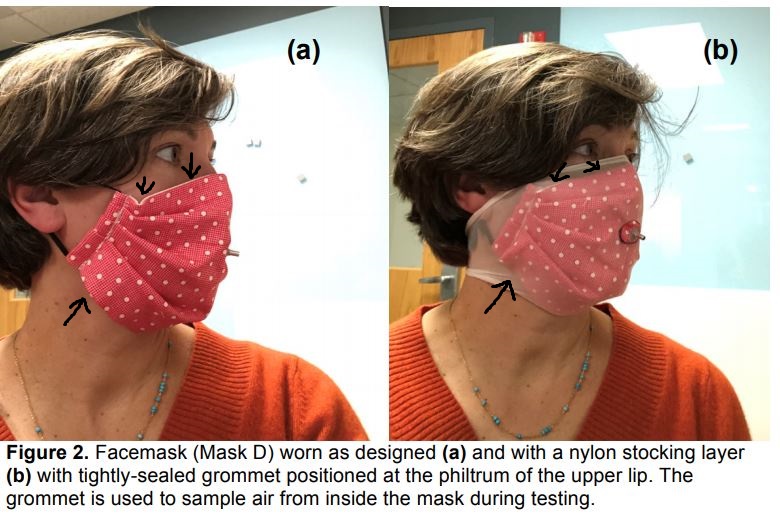
Armed with information, equipment, and a team of scientists, Dr. Fernandez began testings the masks. Particles were generated in a room prior to and during testing while particle counters were recorded by video camera for analysis with one particle counting behind the mask and one counting area on the outside of the mask. These measurements were compared over three one-minute tests with regular wear and one one-minute test with an outer nylon layer to improve mask fit.
Data was calculated and used to create a highly informative graph of efficiency. The blue bar is for the normal wear efficiency with a red bar showing standard deviation and the grey bar shows the wear with a nylon layer with a purple bar for standard deviation. High blue and grey bars show good filtration of particles, while high red and purple bars show there is a lot of variation in measurements.
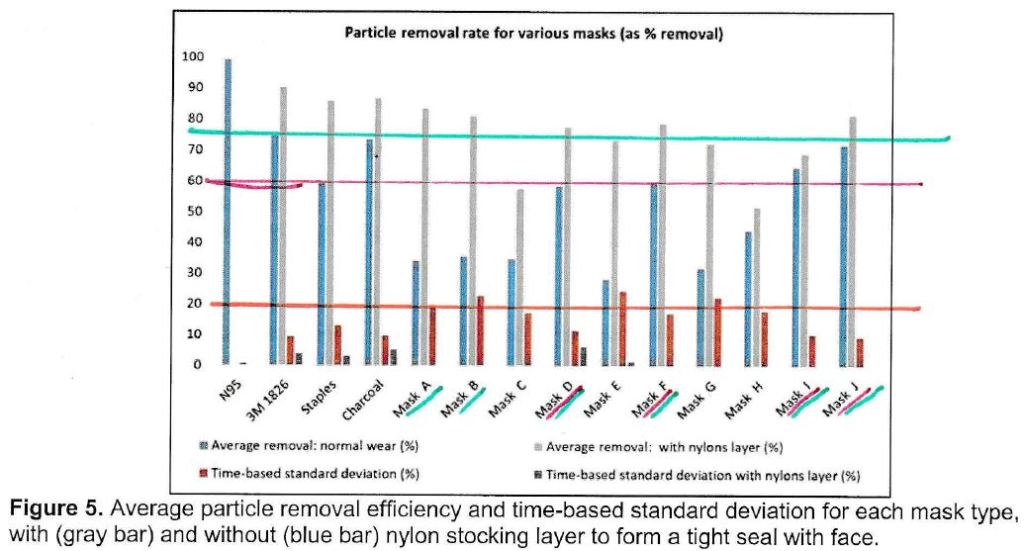
The data shows that N95 masks were capable of achieving removal of greater than 99% of particles as expected, validating testing methodology as well as serving as an experimental control. This is why N95 masks are so valuable to the people dealing with COVID-19 infected patients as the mask it allows them to be in the same space while avoiding the main means of transmission, breathing in respiratory droplets.
Other mass produced masks tested were 3M surgical masks, Staples generic Medical/Dental masks, as well as charcoal filter masks. These masks all performed with at least roughly 60% of particles removed. All masks showed improvement with the addition of a nylon outer layer. Nylon itself may cause some small change in the filtration, but the main function noted in the study is to greatly improve how close the mask is to the wearer’s face. With fewer gaps in the mask, more air must pass through the mask and will therefore gain the filtration benefit. Air that does not go through the mask is not filtered and can still bring in particles.
A variety of handmade masks were also tested, each showing improvement with nylon. Based on the descriptions, the masks were made to mimic surgical masks with multiple layers of pleated cotton. I have included the table listing the masks with my notes from the paper. The lines to the left of the mask show the benchmark they pass in figure 5.
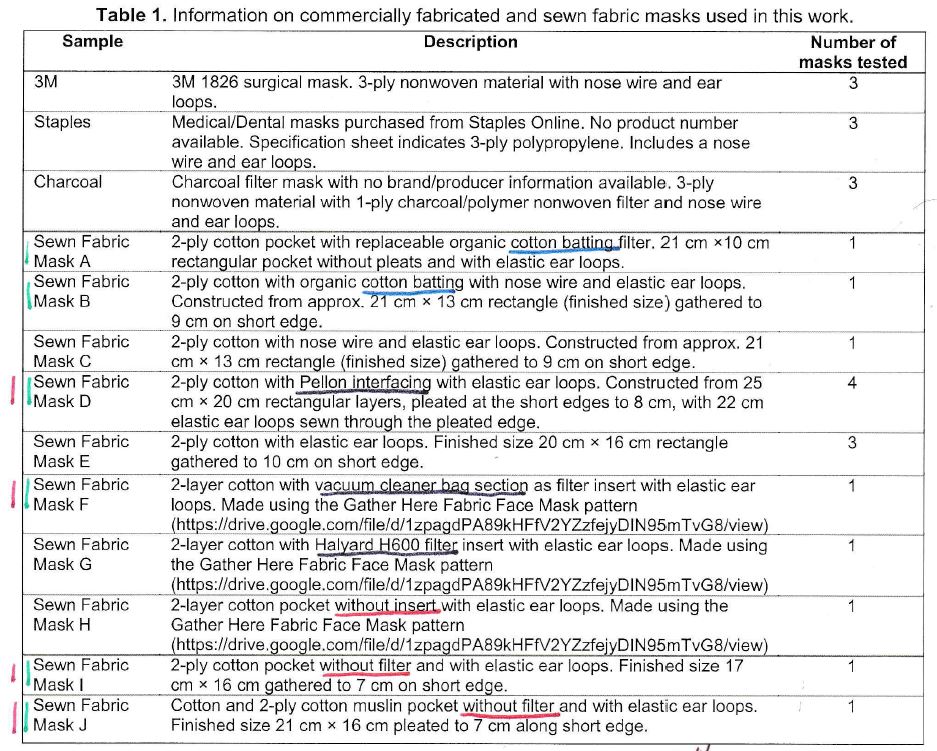
While a few masks make it around or above the 60% filtration (pink line), many more masks are able to filter at least 75% of particles (green line) when worn with nylon as measured by the grey bar. This is where I really wish they included a picture of masks tested so we can see the pattern of the masks, but the table does at least include the dimensions of the mask. Different fillers were found to have some benefit, such as interfacing, cotton batting, and commercial filters but since the vacuum bag comes with a warning that it contained carcinogens and teratogens I would not recommend using vacuum bags as part of your mask.
Takeaways: From all of this data what we can learn is that two layers of cotton are sufficient to filter our particles that can carry SARS-CoV-2 so long as the mask is worn securely to the face. Fit can be improved with a nylon outer layer for any and all loose fitting masks.
Making Cloth Masks
Now that we know masks can help filter out particles that can cause COVID-19, how to we make them properly?
My first recommendation is to find a good mask pattern. I am using the one located here: https://www.craftpassion.com/face-mask-sewing-pattern/ for a few reasons. It is a full face covering mask that can be sewn with a pocket to add extra filtration material and it has a space to allow for a nose wire. To help your mask fit well you’ll always want to have that nose wire present, and it helps prevent your glasses from fogging up too badly which is important. The better fit you can get from your mask, as Dr. Fernadez’s study shows us, the more protective it will be so I prefer more coverage rather than the surgical mask mimics. If you do choose to go with a pleated design then pleat your fabric to be about half of the size it starts as, based on the information available in Table 1.
The fabric you use in your mask matters. Another study published this week Aerosol Filtration efficiency of Common Fabrics Used in Respiratory Cloth Masks performed testing on different fabrics as well as combinations of fabrics across a large range of particle sizes. They essentially validated Dr. Ferandez’s work for the particle sizes she tested and expanded to include a larger variety of materials and particle sizes. Based on their research two layers of close weave 100% cotton do well to filter out particles.
Including synthetics can help filter out smaller particles, but as the air itself has a difficult time passing through synthetics, I would not recommend their use in masks as it may make it more difficult to breathe. It is possible to combine cotton with other natural fibers such as silk to improve filtration, so if you’re truly worried you can add a silk layer inside of any mask you make.
With your fabric you want to use fabrics with tight weave. Hold your fabric up to the light and look for where the light comes through, the fewer the places means the tighter the weave. Personally I am using a duck canvas for my outer layer, as it is a tough, generally close woven fabric, with quilting cotton for my inner layer. I also have one prototype mask that was made with cotton flannel but it’s pretty warm to wear and we are heading into summer.
Mask Wear and Upkeep
Now that we know that masks can filter out the particles that spread the virus and we have made masks, it’s time to make sure we are using them and taking care of them properly.
When you’re putting on and taking off your mask use the straps and avoid touching the area of the mask that makes contact with your face. Since the whole idea of a mask is to act as a filter, where we are breathing through it can become saturated and you are able to pick up some of the nastiness your mask traps when you touch it. The straps are the ideal way to handle a mask since they are not being directly breathed on.
After you put on your mask, it’s time to go out. Masks don’t need to be worn in spaces where you are not worried about spreading or catching diseases, such as your house or your own vehicle; but going to the grocery store, in someone else’s vehicle, or at work is a place where having a mask on is important as there can be so many unknowns.
The condition of your mask is important. Cloth masks are meant for daily use, meaning they need to be washed after being worn for a day. If your The condition of your mask is important. Cloth masks are meant for daily use, meaning they need to be washed after being worn for a day. If your mask gets wet either through rain, splashing, or even breathing you need to change it as soon as practical. For cloth masks, just toss them in with the laundry after use and use a clean mask daily.
On a side note, I recommend against the use of gloves. While they are convenient and can help you feel safe, it’s only with practiced proper use that there is any real benefit. Rather than wearing gloves, wash your hands before leaving your house and upon returning. If you are an essential worker, it’s also a good practice to wash your hands once you get to work as well as when you’re leaving at minimum. By washing your hands you’re removing anything on your skin that could cause a disease when you touch your face.
In Summary
The data is currently showing that wearing a mask can help slow the spread of COVID-19 by stopping the wearer from spreading as well as protecting the wearer from what may be present in the environment. A mask in and of itself is not enough to totally protect you, so continue to practice social distancing, hand hygiene, and avoid touching your face to minimize all chances of transmission.
No matter what you’re using, two layers of cotton with a good fit will be better than nothing. The closer the weave the better, but use what you have and what you can get a hold of.
Good luck everyone and stay safe.
-Colleen
 PMP in the Lab
One thought on “On the Usage of Masks”