There’s little guidance and a lot of questions when it comes to having school in the days of COVID. It can be difficult to sort through everything especially with a lot of information coming from unreliable sources. To help clear the cloud of confusion about COVID-19 in children, this post will look at known examples of spread and severity in kids as well as create a question list for people involved with schools.
COVID-19 in Children
There has been broad recognition to date that while children and young adults are capable of catching COVID-19 they are less likely to have severe symptoms. Overall our lack of information is due to the overwhelming effort of society to protect our children thus minimizing the number of children infected, but as the pandemic drags on more children are being exposed. New information coming from the American Academy of Pediatrics (AAP) states that of all identified child COVID-19 on the 30th of July, 40% had been identified in the past two weeks and children accounted for 8.8% of all COVID-19 cases in the United States. [link]
Not only are children capable of catching COVID-19 but they can spread it too. The best case study of children spreading COVID-19 comes from a summer sleepover camp in Georgia. While the camp did try to mitigate the spread of COVID-19 among campers and staff, the camp was open for a total of 7 days, 4 with just staff plus 3 with children, before the camp closed and everyone was sent home after one staff member tested positive for SARS-CoV-2. [link]
The camp used mitigation strategies to minimize risk such as creating small, isolated groups to minimize wide spread, mask use by staff, and requiring a recent (≤ 12 days) negative COVID-19 test. Even with all of these in place one staff member fell ill on the 3rd day of the camp after children had arrived. Due to the range of times it takes to experience symptoms of COVID-19, 2-14 days, there’s every likelihood that at least one person was a carrier of SARS-CoV-2 that had picked it up after their testing and were able to spread it through staff, trainees, and campers. These asymptomatic or pre-symptomatic carriers risked infecting all 597 attendees of the camp.
344 people at the camp were tested through tracing efforts and 76%, or 260 people, tested positive for the virus after the camp was shut down. These are people who had a clean bill of health before attending the camp thus making the camp the likely location of the spread. The infections were concentrated in staff members, who attended the full duration of the camp. Campers arrived after spread was probably established in the adult population and were likely exposed by the adults or possibly had children present who were asymptomatic carriers. SARS-CoV-2 was able to infect at least 44% of all people involved with the camp in the course of a week who were spread out through multiple cabins and made efforts to keep groups separate.
While there is no follow up for the severity of COVID-19 in the children exposed at the summer camp, a study out of China in early August looked at over 300 infected children to track severity of symptoms. Nearly 6% of cases in children were asymptomatic and 30% of those asymptomatic children were found to have abnormal chest x-rays. This means that even without experiencing COVID-19, the children were found to have problems in their hearts, lungs, livers, and other important organs found in the abdominal cavity due to the infection. Of the symptomatic children 78% were found to have fever and 32% were found to have coughs which roughly matches the major symptoms in adults. 93% of children were found to have mild to moderate cases. [link]
School Opening Lessons to be Learned
Here in the USA only a few schools are opening up but all of the current news seems to be coming out of Georgia. While most school districts say they are going to have students (of all ages) wearing masks and social distancing, recent pictures are showing flaws within the system.


The school featured in hallway picture, North Paulding High School in Georgia, has now had to close down and shift to online learning after COVID-19 infections were reported in 6 students and 3 staff members. This shutdown comes one week after the school opened on August 3rd. While the people infected now likely didn’t catch COVID-19 at the school the now sick people exposed everyone they came into contact with or were near during their time at school. [link] A recent CDC study showed that 33% in a sample of COVID-19 positive children aged 5-17 years needed admission to the ICU, showing that children can have as severe symptoms as adults. [link] That means that up to one third of the possibly hundreds of people exposed during 1 week of school could wind up in the ICU, staff and student alike.
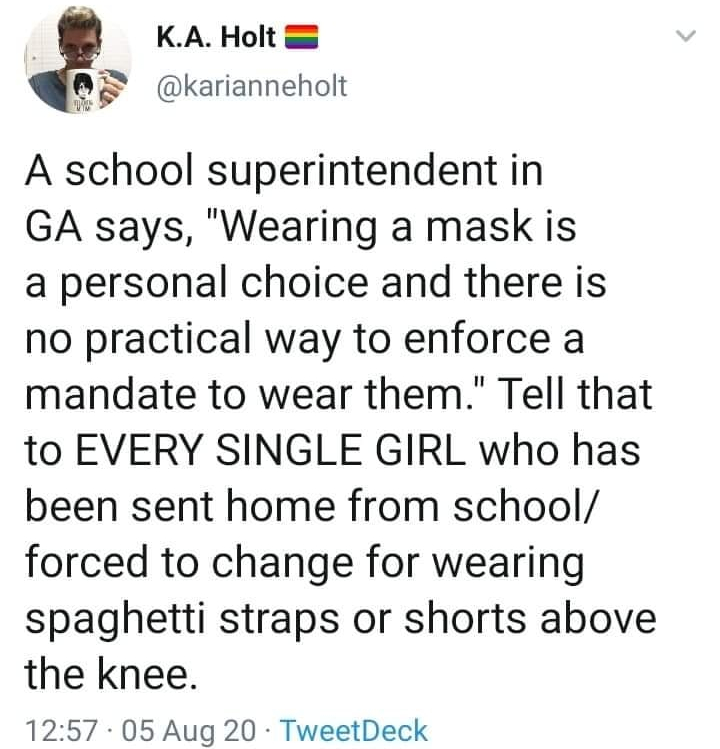
One of the most bizarre reactions coming from school districts is the sudden inability of schools to establish a dress code including a mask. These same dress codes for years have included mandates about appropriate hair styles, shoulder coverings, and skirt lengths but suddenly asking students to wear a mask is too much. While everyone can understand difficulties for younger students, who let’s face it sometimes struggle to wear pants all day, it should be possible to have middle schoolers and onward in masks while inside. The fight against masks is one that lets the virus win. Masks work. [link]
Some countries have been able to safely reopen schools due to strict measures in place and low community transmission. Just like workplaces, temperature checks are an easy way to monitor everyone for fever and have been implemented in schools in Asia and Europe. Mitigation strategies in addition to mask use have included limiting class sizes, installing partitions between desks, closing shared spaces, and moving more activities outdoors. With all of these strategies resources are desperately needed by schools to pay for the changes as well as additional hygiene supplies like hand sanitizer and cleaning wipes. [link]
Another strategy being used throughout the world is to form “bubbles” where people limit their exposure by only interacting with people inside of their bubble. These bubbles contain limited groups of people and those they come into contact with. For students their bubble is the group of students they interact with at school to limit the spread in case a single student gets sick.
Sadly, like every group project it takes everyone’s cooperation to succeed and the bubbles must be maintained. The National Hockey League (NHL) and National Basketball Association (NBA) are examples of the success of the bubble strategy and have minimized the spread of COVID19 in players and staff. Major League Baseball (MLB) has not initiated such a plan, opting to control spread through other measures, and has canceled games to prevent COVID-19 spread between teams. [link] Israel attempted a bubble plan for students however after waiving mask requirements and increasing class sizes the country saw a boom in COVID-19 cases country wide that is believed to have started at the schools. [link]
No matter what path schools take safety must be a consideration for everyone present, students and staff alike.
Questions & Protocols for Safe Schools
For schools to open safely, there must be accommodations and flexibility. Just as the world hasn’t returned to normal, we can’t expect schools to snap back to full functioning without there being a cost. Only with smart plans and the will to shut down again in the face of an outbreak should any school be looking at opening. School closings in the face of an infectious disease outbreak are now an uncommon occurrence but have been enacted since the early 1900’s. [link]
At the same time, no one plan will work in all locations. Below are some questions I have pieced together from articles and discussions with friends and family to ask your schools to help build the right environment in school or online.
- What type of screening will be done upon entering the school?
- Will everyone be screened? Only students? Only staff?
- What will happen if someone is found to have a fever upon screening?
- How will schools deal with children who are obviously ill?
- How will schools deal with children who need to be sent home and no parent is available to get them?
- If a person receives a positive COVID-19 test result, who will need to quarantine?
- How long will any school mandated quarantine last? (Recommendation is still 14 days [link])
- Will people who have recently (within 3 months) recovered from COVID-19 be allowed to not quarantine?
- Will teachers have to use sick leave to cover quarantine?
- Will teachers in quarantine still be responsible for teaching?
- Will teachers at school be responsible for both in person and virtual classes?
- What support will teachers have for teaching virtual classes?
- Will non-teacher staff (janitors, lunchroom workers, aides, etc.) be required to quarantine?
- Will the school require masks?
- How will the school respond when someone doesn’t have a mask?
- How will the school respond when someone refuses to wear a mask?
- Who will be paying for the extra hygiene supplies?
- What Personal Protective Equipment (PPE) will the school supply?
Summary
As much as we all want the world to return back to normal, there’s a long way yet to go before that’s possible. Only with hard work at minimizing the spread of COVID-19 do we have a chance before there’s a vaccine. Right now we have to focus on buying time and keeping people safe while scientists do their best to find cures and create vaccines.
It’s hard work and masks suck, but we have to keep it up before we get back to normal.
To the teachers who are now on our front lines, we support you,
–Your friendly neighborhood scientist
 PMP in the Lab