It’s been a pretty busy few weeks for COVID-19 news so it seemed time to delve into a few headlines.
WHO and Lockdowns
The first recent COVID-19 news that had big headlines was that the World Health Organizations (WHO) had changed its stance on lockdowns, no longer recommending them as a means of controlling the spread of COVID-19. This happens to be a convenient misinterpretation of what was actually said. At this point, most of the northern hemisphere of the world have been under some form of lockdown since March causing problems such for mental and physical health [link] as well as having economic repercussions. All of the costs of the shut down are recognized and need to be taken into consideration before implementing a shutdown. What was actually said by Dr. Michael Ryan, executive director of the WHO’s health emergencies program, was the following:
This [lockdowns] may be unavoidable where the disease has got out of control again but we shouldn’t accept that in every country the return of cases should be seen as an immediate return of the need for lock-down restrictions at a national level. There are many things that can be done between those two points and we should make every effort to do so in order to keep our social and economic lives open and particularly schools and other vital services.
Transcript from COVID-19 Virtual Press Conference, 09Oct20 [link]
After a media blitz starting on October 12th, the WHO released an FAQ discussing herd immunity and clarified their stance on the use of lockdowns. The truth is that the WHO supports lockdowns as one of many tools to be used to gain control of an epidemic. The WHO FAQ answer specifically states that lockdowns should be times when governments martial resources to detect, isolate, and treat cases while building up their ability to trace, quarantine, and engage with populations at a local level to bring the spread of the virus back down to controllable levels. Here controllable levels specifically means levels where the government is able to treat cases, trace to the cases’ contacts, test and quarantine when necessary. [link]
The WHO sees lockdowns as a temporary measure put into effect to minimize the spread. If an area is able to lock down well enough it only takes a few weeks for SARS-CoV-2 to run out of hosts to infect. Exposures could be efficiently traced from the few people that are sick, and everyone can resume living their lives with social distancing and mask use until a vaccine is produced. If lockdowns are weak and only have a small change in spread then a lockdown will last longer as it takes more time to gain community control due to ongoing spread. In a previous blog post [link] I discussed the types of lockdowns and it seems that we are now stuck in the dance with no relief in sight.
CDC July Report and Mask Use
In September the CDC published a paper wherein scientists spoke with 154 symptomatic COVID-19 patients and 160 SARS-CoV-2 negative control patients at the same clinic, all at least 18 years of age, about their habits during the COVID-19 pandemic. COVID-19 patients were more likely to have had contact with someone who had COVID-19 and were more likely to have eaten at a restaurant than control patients. For those symptomatic patients without known exposure, they were more likely than the control groups to have dined at a restaurant or gone to a bar or coffee shop. Importantly, for those who reported contact with a known COVID-19 patient, half of the COVID-19 contacts were with a family member which shows the disease’s ability to spread within a household. [link]
Another question asked of everyone participating in the study was the frequency of their mask use ranked as never, rarely, sometimes, often, or always. The authors found no significant difference in mask use habits between the COVID-19 patients and the non-infected controls. Note, this study did not focus on how the use of masks changes infections rates! This was just part of the study on the habit of people who got sick with no significant findings on mask use.

Somehow, this information became summarized by Tucker Carlson as “Almost everyone — 85% — who got the coronavirus in July was wearing a mask, and they were infected anyway.” [link] The quoted 85% of use comes from the people who said they wore the mask Often or Always. This idea of masks being ineffective though spread very quickly because of the appeal of not having to wear the annoying things anymore. Because the study focused on a specific subpopulation rather than the population as a whole, this can not be considered evidence that masks don’t slow the spread of COVID-19. There’s also a possible issue of bias in respondents due to the nature of self reporting. No one wants to tell the nice, serious COVID-19 researcher that you take your mask off at every possible opportunity.
What we’ve seen with this virus is that everyone is able to get this disease with even very limited exposure and just one outing to a bar or restaurant where other people are lax in mask use is enough to catch the virus and develop COVID-19. What this study does not change is the fact that mask use does have incredible power to decrease the spread of COVID-19 for first responders [link] or for the general populace [link].
COVID-19 Misinformation Super spreaders
The final thing I want to post about is what ties both of the previous topics together, the insidious nature of COVID-19 misinformation. A group of researchers at Cornell and Cision Global Insights performed an analysis on the “infodemic” of misinformation. The study looked at misinformation spread between January 1st and May 26th of 2020 to categorize and catalogue topics and sources [link]. Researchers collected 38 million news articles published in English from around the world and categorized the articles based on keywords.

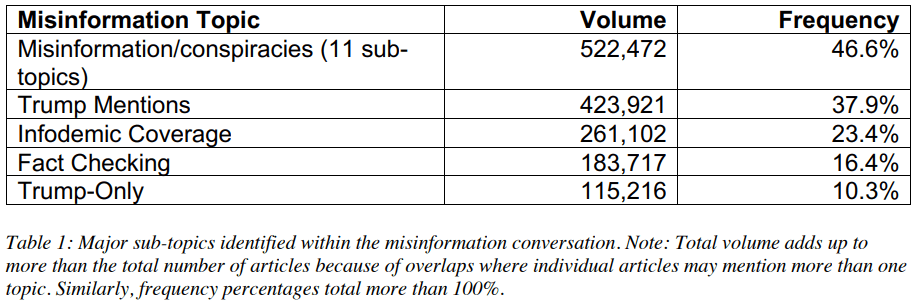
Articles were separated into 5 overlapping categories of Misinformation/conspiracies, Mentioned by Trump, Infodemic Coverage, Fact Checking, and Trump-Only. While the exact reason is not stated, since before his presidency Trump was known to spread conspiracy theories and his current status is likely the reason for inclusion as a category in the study. The Misinformation/conspiracy section was separated into 11 sub-topics displayed in the paper’s figure 3 above.
While the topics vary greatly, it is clear that miracle cures were the main subject of attention. It makes sense as what can generate more clicks or sales than offering a miracle cure in the midst of a novel disease outbreak? It seems another driver of misinformation is Trump, as Trump mentioned or actively shared misinformation in 37.9% of the articles included in the study. The good news is that 16.4% of misinformation was being fact checked in the article, sadly this blog was not included as WordPress posts were excluded.
From this we need to learn that where we get out information from matters greatly and that some people are better sources than others. There’s so much misinformation being spread even now. So go forth and be careful in your readings, the misinformation will probably grow in speed as we head towards the first vaccine releases at the end of this year.
Stay strong,
-Your friendly neighborhood scientist
 PMP in the Lab