
Today’s blog post is going to look at what’s going on with Minks in Denmark that hit the news this week. While the first cases were reported in June, months of additional tracking and sequence comparison led to the conclusion that a variant of SARS-CoV-2 mutated and is now capable of spreading between minks and people.
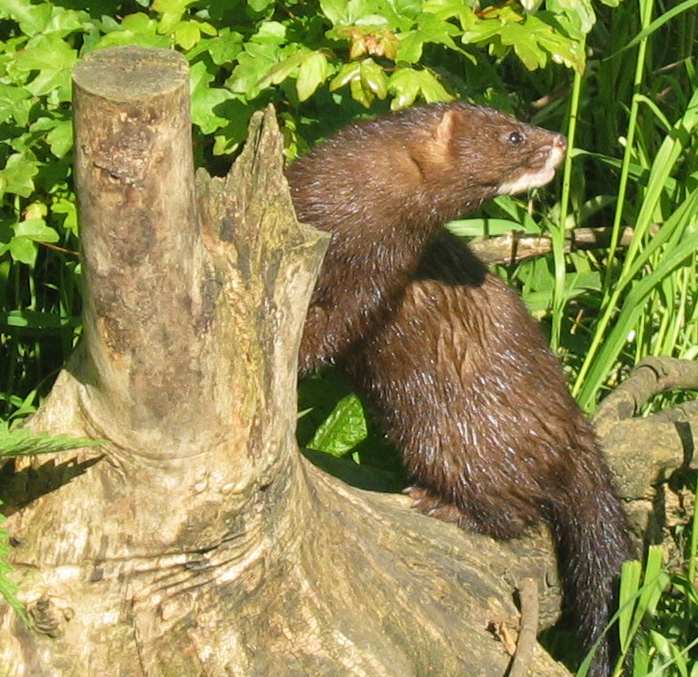
While we know that SARS-CoV-2 originated in bats [link] it has been found to be able to infect a wide range of animals after exposure through a human sick with COVID-19 [link] though none of those animals had been found to be able to transmit SARS-CoV-2 back to people, being what is called a dead-end host. In fact, one of the best animal models for studying COVID-19 has been the ferret, a close cousin of minks which share the genus Mustela. Beginning in June, Denmark saw an increase in COVID-19 cases and traced the cases first to fur farms and then to the fuzzy inhabitants.
What was remarkable about the cases is that this is the first document transfer back to humans from a new species, mink, and the first to occur since the virus’ species hop back and forth between humans and animals. An outbreak in the Netherlands led to culling more than 10,000 mink and another outbreak in Spain led to almost 100,000 more animals being disposed of. When SARS-CoV-2 of the mink was compared to that of the local humans the viruses were found to be similar to the viruses spreading throughout the world. [link]
This outbreak occurring in Denmark is different in that the mink and people are spreading for a novel and meaning mutant of SARS-CoV-2. The reason that the minks are now making headlines is that the WHO is reporting 12 cases identified in September that are shared with minks and constitute a “unique variant” (their words) of SARS-CoV-2 that may constitute enough of a difference that this new form of the virus called the “cluster 5 variant” will not respond to ongoing vaccine testing. [link] The WHO says that the virus showed decreased sensitivity to neutralizing antibodies, or that current antibodies didn’t attach as well do this new variant as the SARS-CoV-2 being passed around the rest of the world. What this means practically is that we have now seen the first variant of SARS-CoV-2 that vaccines currently in development would not be affective against. New variant sequences have not been published so scientists have yet to see what the mutations constitute and just how bad this may be.

All that being said, there is currently no reason to panic. The fact that COVID-19 hopped species isn’t surprising considering that it hopped species roughly 1 year ago to be able to infect humans and start this whole mess. Additionally, the fact that a variant of SARS-CoV-2 arose that may not be targetable by current vaccine efforts isn’t surprising either since coronaviruses are kings of change which is part of the reason why people will get a cold every few years. The speed of mutation in coronavirus isn’t what drove this change, it’s far more likely to be because there was an extra sick mink in Denmark that a SARS-CoV-2 virus was able to pick up some extra information from another virus and generate these new variants. maybe? We’ll know more when the sequence gets released.
There are 12 human cases of this which is an extremely small number because early detection caught it and the WHO has taken swift action in evaluating the cases. All cases are currently in Denmark and to prevent further spread through human or mink populations, the humans sick are being placed under extra precautions while the areas where these people live are being monitored for further spread of the variant while Denmark is going to cull all of their farmed mink to eliminate any possibility of further spread in farmed or wild mink populations. For those worried about the animals, they will be put to sleep using gas and will not feel pain. All of the farmed mink will be incinerated to eliminate all traces of the virus before disposing of the remains, this is to protect the wild mink populations from catching the variant and becoming a reservoir host for this SARS-CoV-2 variant.
A reservoir host is capable of hosting a disease without serious illness but can serve as a source of infection. The last thing the world needs is another avenue for the spread of SARS-CoV-2 much less a variant capable of surviving in wild populations that are difficult to control and could lead to continuous outbreaks of disease. This is also a warning that there are animals that can not only become sick with COVID-19 but can become the type of host that may become a reservoir for future infections. Examples of reservoir hosts are found throughout the world, my favorite example is that Prairie Dogs are reservoir hosts of Yersinia pestis meaning that even locations you wouldn’t expect like Texas have endemic bubonic plague.

What’s going on in Denmark is not a cause for alarm, but it is a warning sign that eliminating SARS-CoV-2 will not be an easy task and that we have to take precautions when working with an around animals that can catch this disease.
Keep masking, distancing, and washing your hands; protect our fuzzy friends,
–Your friendly neighborhood scientist
 PMP in the Lab