A new vaccine is now in use and some parts of the US are seeing up to 10% of the population fully vaccinated. I’ll have to admit that the beginning of 2021 is beating my expectations, here’s hoping the variants don’t crash the party.
Johnson & Johnson Vaccine Data
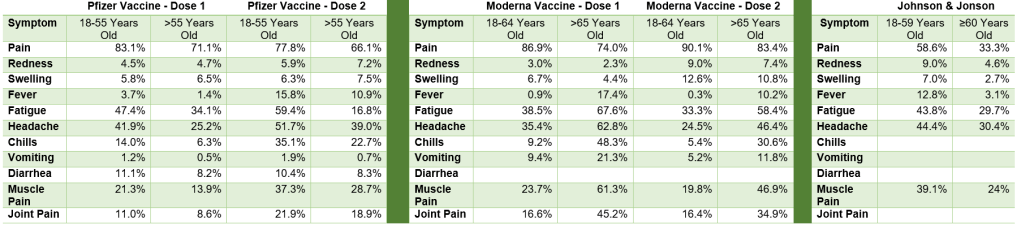
With the release of the Johnson & Johnson vaccine, we’re able to compare the side effects of the different vaccines. While there’s less data to include on the table, it’s obvious that the J&J vaccine can be the gentler option for people worried about side effects. Another benefit of the J&J vaccine is that it only needs a single dose. This allows it to be more easily given to people who have difficulty in traveling such as the elderly or isolated populations. This vaccine is simply more convenient as it can cause milder reactions, can be stored at normal refrigeration temperatures, and be fully administered with a single shot. [link]
What has some people worried about the vaccine is that it is less effective than the mRNA based Moderna and BioNTech vaccines as it is has a roughly 70% efficacy while the other two have around 95% efficacy. There are a few reasons for this.
- Encounters with Variants – All of the vaccines train the immune system based on the original SARS-CoV-2 spike protein. The Moderna and BioNTech trials took place while there no primary variants of SARS-CoV-2 with spike mutations while the J&J trials took place not just after the variants arose, but in the countries where those variants were common such as South Africa (Variant B.1.351) and Brazil (Variant P.1). Since the variants have mutations on the spike protein, they can limit the sites where antibodies trained to the original SARS-CoV-2 Spike can attach which can lower efficacy which is seen in both of the mRNA vaccines. [link]
- Delivery – The J&J vaccine encodes the SARS-CoV-2 spike protein as DNA and delivers it to your cells using an adenovirus. While adenoviruses are not harmful and can’t replicate in human cells, they can still elicit an immune response on their own. This DNA vaccine has a harder job then the mRNA as it needs not just to enter the cell, it needs to enter the nucleus where the spike encoding DNA can be turned into mRNA that allows for the cell to generate the protein to elicit the immune response. It’s possible that the extra steps of using DNA can cause a change in efficacy as essentially there is an extra step with barriers to overcome. [link]
All of that being said, the J&J vaccine is still highly effective in preventing hospitalization and death. The vaccine is totally worth getting and may even be the best choice for some populations.
Getting Vaccinated
Now with three vaccines released for emergency use, the opportunity for vaccination is increasing to the point where more people are beginning to become eligible. However there’s been a lot of hesitancy because some people who are eligible are holding back. I want to give you all permission, here and now, to go get your vaccines when you are eligible! Having as many vaccines out in the population is going to be what helps us end this pandemic, the priority groups are set up the ways they are for a reason so when you become eligible, you’re eligible for a reason.
Go get your shot when you can everyone! We’ll only end this by getting vaccinated together!
CDC Vaccinated Guidelines
So after you get your vaccine, what then?
The big news from this past week is that the CDC release guidelines for fully vaccinated individuals! This is the first step that the CDC has taken is signaling a change from our preventative steps that started roughly 1 year ago. A study in Israel published this week showed that vaccinated healthcare workers not only reduced COVID-19 infections in the vaccinated individuals at rates similar to earlier data, but also showed a decrease in asymptomatic cases. [link] Unlike a lot of other diseases, COVID-19 is able to be spread while individuals are asymptomatic and has been a likely driver of transmission since the beginning of the pandemic. Seeing a decrease not just in symptomatic cases but in asymptomatic ones is a likely sign that transmission from vaccinated individuals will be lower. There’s early information of another Israeli study that supports this, but as it hasn’t been peer-reviewed and published yet we’ll rely on the data that has been.
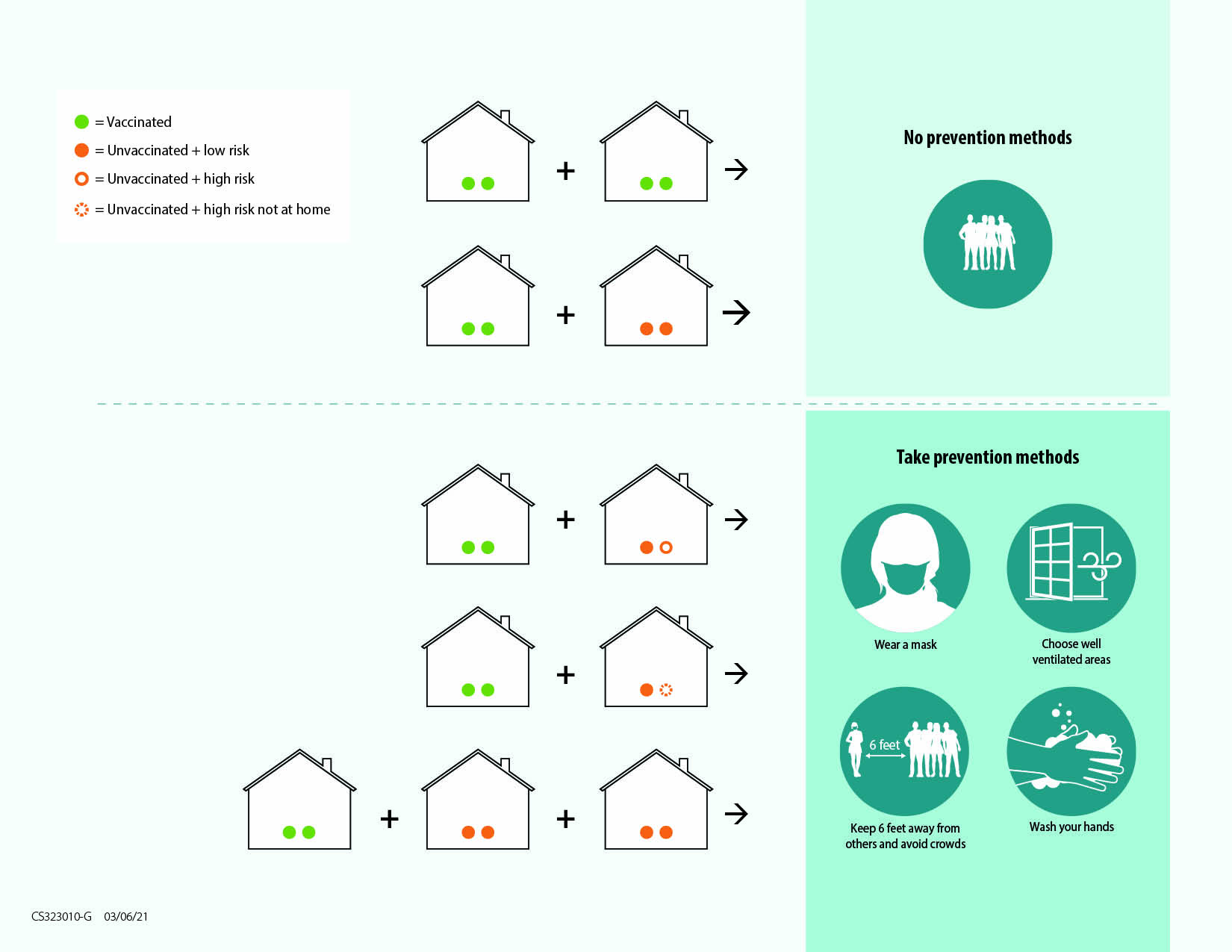
Before people get too excited, now is not the time to get together in large groups and stop wearing masks in public. What the CDC advises and science supports it that vaccinated individuals continue practicing all COVID-19 prevention measures in public to include masking, distancing, and frequent hand washing among other prevention measures. Another thing that we are still advised against is getting together in groups larger than a household or two, that means no 30 person parties or heading out to sporting events for us just yet. The reason for all of this is that we have yet to bring COVID-19 under community control in a majority of the country. There may be small areas that are getting close, but they could also be one kegger away from another outbreak, so keep the drinking in house without a bunch of friends.
What we can do is allow vaccinated people to start visiting each other, and small numbers of unvaccinated individuals. This means that when someone hits the 2 weeks post 2nd vaccination mark for the mRNA vaccines or the 2 weeks post vaccination mark for the J&J vaccine, you can invite some vaccinated or unvaccinated friends over for a meal and hangout. These precautions mean that vaccinated people are able to visit unvaccinated people at low risk without taking precautions, such as grandparents being able to interact with grandchildren outside their bubbles again. For me, this past weekend was spent with my unvaccinated sibling, spouse, and adorable 8 month infant. Just being able to drive someone else for a few hours was freeing and some family time playing board games was desperately needed. Though the CDC doesn’t specify, I would advise spacing out such visits by at least a week to ensure that no one gets sick after visiting as you can still catch COVID-19 after vaccination. [link]
Our approach to the COVID-19 pandemic has shifted into its final phase now where we need to make it through one last stretch while more of the population gets vaccinated. We’re not in the desperate phase where we’re just trying to prevent our hospitals from becoming overloaded, instead the goal needs to be getting community spread under control through simple prevention measures and minimizing the number of people who will ever be sick from this again. At this point, the more we allow COVID-19 to spread, the greater chance we give SARS-CoV-2 to mutate in ways that can cause further problems. That would be bad, so don’t let the virus win and stay vigilant.
We’re almost there, I hope you get vaccinated soon
-Your friendly neighborhood scientist
 PMP in the Lab