

Since mRNA is a relatively new player in the vaccine field, I want to give a quick rundown of manufacturing as an explanation of the different types of vaccines and then focus on how mRNA is designed and made to help explain why scientists so sure in the safety and efficacy of these drugs. There are a lot fewer links in this post as I’m relying on my 6 years of experience in mRNA development and manufacturing.
Types of Vaccines
There are 4 major types of vaccines, live attenuated, inactivated, toxoid, and subunit. [link]
There is written record of Chinese practitioners grinding up smallpox scabs and having other people inhale them as the earliest known form of inoculation, the act of exposing people to small amounts of a disease to build up an immunity. [link] Even though there were methods to keep doses small, there was always the possibility of a person developing the disease from these small inoculations and people were desperate for an alternative.
The first use of a different disease to prevent infection was using cowpox to create immunity from smallpox, which is considered an live attenuated vaccine as there is 1. a live virus being used and 2. the live virus being used is milder than the actual disease. While some people may thing this type of vaccine can cause people to get seriously ill, it is an extremely rare occurrence as the most dangerous drivers of the virus aren’t present. We use these vaccines today for the MMR (measles, mumps, rubella), Chickenpox, and Rotavirus vaccines and even eliminated smallpox through using a live attenuated vaccine.
The next type vaccines developed when people were inactivated vaccines where a live virus or bacteria is strategically killed and inactivated before being used as a vaccine. While the idea of inactivation seems simple, it is actually a tricky process to both kill a pathogen and leave enough parts whole that it can train the immune system. These vaccines don’t tend to give as strong immunity as the process of inactivation may cause your immune system not to act as strongly as it does against a live virus. Our annual flu vaccine is from inactivated virus, as well as rabies and polio vaccines.
Toxoid vaccines use the toxin from a bacteria to elicit an immune response. The first experiments with these vaccines were performed in the early 1900s when researchers found that exposure to diphtheria toxins could prevent diphtheria infection in guinea pigs. By training the body to recognize a toxin produced by a pathogen, the pathogen can also be identified by the immune system and eliminated. We still use toxoid vaccines to prevent diphtheria around the world.
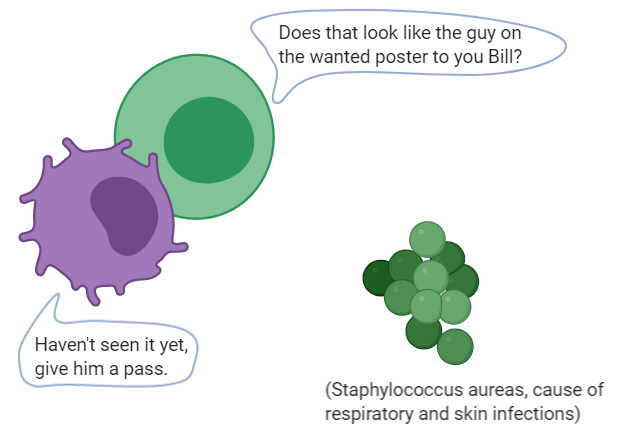
The final type of vaccine is a subunit vaccine, where like the toxoid vaccine just a part of a pathogen is used to get the immune response. This is where we find our mRNA vaccines as they are able to tell the cell how to make the subunit that can then be used to train the immune system. Subunit vaccines can use a protein, sugar, or a part of the casing around a germ known as a capsid to train the immune system. These vaccines yield strong reactions to the part that is shown, so it is possible that a pathogen could evolve in such a way that vaccines could no longer be effective but there is no current data I know of to show that it is occurring. Whooping cough and singles vaccines are both subunit vaccines.
A modern take on live attenuated vaccines uses genetic engineering to take a virus that doesn’t cause disease in people and give it subunits from a virus, such as the spike protein from SARS-CoV-2, to have the virus train the immune system to react. This is actually the safest way we can develop live attenuated vaccines going forward as we will no longer be dependent on what can be found in nature but in what we can generate ourselves. While genetically a engineered vaccine has been used as the cause of the apocalypse in I Am Legend (2007), we’re finding that these vaccines are safe and effective during early clinical trials. CanSino and Johnson and Johnson are using this type of vaccine for their COVID-19 vaccines.
Designing an mRNA vaccine
As I mentioned in my last post, there’s a lot of work that goes into designing mRNA for a vaccine. [link] Each portion of the RNA can be optimized to allow for it to produce the most protein it can and to be as stable as long as possible within the cell. Here are some very broad notes on the parts of the RNA. The 5′ untranslated region (UTR) gives the cell signals about translation, this region can even have codes that enhance or limit translation. The 3′ UTR performs a similar function focusing on signals about stability. What is encoded in the coding sequence determines the protein that can be produced, and using specific codes in the RNA can slow down or speed up the building of proteins. The poly A tail at the end functions as a buffer to prevent the RNA from being degraded, like the aglet at the end of your shoe lace.

When you’re able to design an mRNA for a vaccine, there’s a lot of leeway in how to make it the best mRNA it can be. A lot of time there are extra signals in the 5′ UTRs of natural RNAs that you don’t want in a vaccine, but since the entire thing is designed it is easy to eliminate the signals in sequences that you don’t want. Minor changes all across the mRNA can have large effects, dozens of mRNA variants may be tested before a single mRNA is ready for full testing at large companies like Moderna. (No really, I’ve seen slides and just wow… they’re incredible)
The big important thing of mRNAs is everything that gets left out. You don’t need to have signals to make the RNA for the cell, so the RNA won’t replicate unless you put it in. You also don’t need to encode a whole virus in the mRNA, just the subunit that you want to express. mRNAs are being used in a lot of research right now to help treat rare diseases and to create signals that specify cell types. While we may not know what every bit of sequence does, scientists do know enough that they have general ideas of what to include and what to ignore.
Manufacturing an mRNA Vaccine
After the mRNA design is done, it’s time to bring it into manufacturing. mRNA manufacturing is currently based on an enzymatic reaction from a DNA template, where the DNA is used as the recipe for the mRNA, so the mRNA is converted into a DNA sequence and placed into a circular piece of DNA called a plasmid. The reason we use DNA plasmids is that they are easily replicated in E. coli so rather than trying to synthesize long pieces of DNA or RNA, the E. coli produces DNA for us. Plasmids are easily and cleanly separated from E. coli during purifications that can yield high amounts of DNA to be used as template. Further preparation is done by using an enzyme to cut the plasmid so that the enzyme used to generate RNA can simply fall off of the DNA rather than transcribing the entire plasmid.
Now that the DNA template is fully prepared, it’s time to make your RNA during an in vitro transcription (IVT) reaction. In vitro simply means that it is being performed outside of living things, in this case a tube or some other kind of vessel. This reaction requires several parts, the DNA template recipe for the RNA, an enzyme to transcribe your RNA, ribonucleotides that will be linked together by the enzyme to form your RNA, and a buffer to keep the reaction running. The reaction gets combined and is left to incubate for several hours, the enzymes do all the work to generate the RNA. After the incubation is complete, it’s time to purify your RNA from everything else in the reaction.
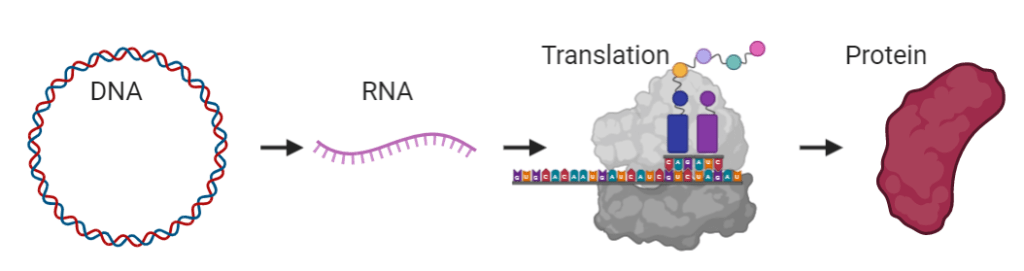
Purification has been pretty tricky for mRNA for years, but recent breakthroughs by people like Katalin Kariko, who now works for BioNTech, and higher quality of IVT reagents have allowed for better purification methods that allow for qualities good enough to be used in clinical trials and mass manufacturing. If you don’t generate a very pure product, then the remnants from the processes get carried along and can cause problems to any cells that get treated. These purified RNAs get packaged into lipid particles for delivery into cells, where the lipids look similar enough to your cells’ membranes that they are absorbed and able to release their cargo of mRNAs. Once the mRNAs hit the cytoplasm, they are found by ribosomes that begin to translate them into proteins. These proteins are what actually cause the immune response and train the immune system to recognize invading pathogens.
mRNA Vaccination
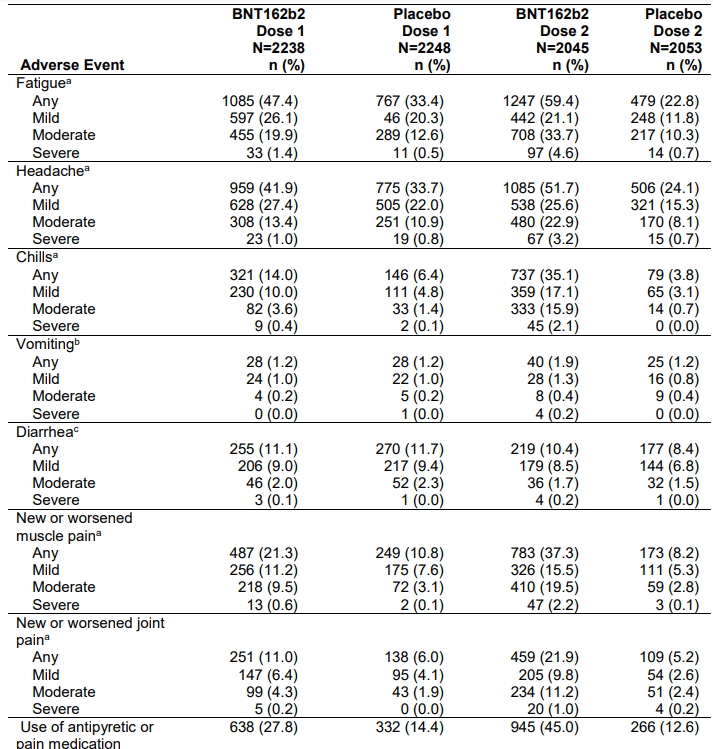
So basically, the mRNA is a way to allow your body to produce its own subunit vaccine! Like other subunit vaccines, these can be really potent and can create strong immune responses which is why we see side effects for the 12-24 hours after the vaccine is given. The reaction is typically stronger after the second shot because your body then has an idea of what to look for and can generate a larger immune response. The symptoms of fatigue, headache, body ache, and even fever and chills are all signs of your immune system generating a response. Because this vaccine is only a subunit, you’re not getting COVID because it’s not there for you to catch.
A lot of questions have been asked this week focusing around long term side effects of mRNA vaccines. Part of the reason for this is well founded questions about a new technology, but mRNA vaccines have been in clinical trials since 2008 [link] and the studies that were stopped were done so for efficacy reasons, not safety ones. So even though it seems like there’s only been a short time to develop and watch this vaccine for side effects, vaccines generally don’t have long term side effects to begin with [link] and mRNA is broken down quickly in cells so there’s little chance of prolonged effects because the vaccine isn’t there. As much as people talk about the COVID-19 vaccines being the first ones, they’re built on decades of science and testing from researchers who are just trying to make the world a better place.
Other people may be concerned about the short timeframe for development and testing, wondering if corners were cut to bring this to market faster. The truth is that while clinical trials usually take 10 years, it’s because of bureaucracy and funding limits. With extensive government support, companies were able to throw more resources at developing these vaccines than anyone had ever even dared to imagine. Combining funding with close coordination with regulatory agencies help smooth the bureaucracy issues that creep in because issues with paperwork were dealt with immediately. By testing the vaccines in 30,000 people during clinical trials, they were able to get information that would take years with only the normal 3,000 participants. No corners were cut, it’s just that the journey from idea to commercial vaccine had all of the potholes filled in what has always been a bumpy road.
The last concern is focused on the mRNA itself as people see that and think it’s able to change the DNA in cells. Good news, it can’t do that. Only DNA is really good at interacting with DNA, mRNA just isn’t made for that purpose. Additionally, the mRNA is targeted to enter the cytosol where it can be functional so there’s no way it can even interact with DNA in the nucleus. mRNA is an extremely clean and safe way to generate genetic therapies and has 0 chance of turning you into a GMO.
Hope this helps answer some questions about why scientists are so confidant in the safety profile of mRNA vaccines. They’re cleaner, simpler, and purer than a lot of other methods and have enormous potential… even if getting the shot might cause some discomfort in the next 24 hours.
Stay strong and prepare to roll up those sleeves,
–Your friendly neighborhood scientist
 PMP in the Lab
I like this article, but not the last part where you assert that, “mRNA is an extremely clean and safe way to generate genetic therapies and has 0 chance of turning you into a GMO.”
There is actually a theoretical chance that it could become integrated in the DNA, although current evidence has not shown this happening. I think your assertion is a little premature and perhaps implies a bias on your part?
Just a thought.
LikeLike
For mRNA to become integrated into a mammalian genome there are critical sequences that must be present on the mRNA and specific proteins for reverse transcription to be present in the cell. If the mRNA isn’t designed to have the critical sequence then there’s no target for the reverse transcription proteins to bind and it is virtually impossible for the mRNA to become DNA that can then integrate with the genome. Until there is strong evidence showing that this happens with meaningful frequency, I think it is safe to say that mRNA won’t turn you into a GMO.
LikeLike
“virtually” – There is evidence that immunity is passed from mother to child. GMO Genetically modified organism, A genetically modified organism is any organism whose genetic material has been altered using genetic engineering techniques. I think it is fair to say injection of RNA, to infer immunity against similar is a technique. Not to get all technical but it does alter genes;
“Multiple inherited (germ-line) gene segments are used in different combinations to generate diversity. Recombination of human heavy chain variable (V), diversity (D), and joining (J) gene segments builds a functional VH chain; and recombination of light chain V and J genes (which are either kappa or lambda isotypes) builds a functional light chain. To build a functional human heavy chain variable region, there is a random assortment in which one of 39 functional V genes is coupled with one of 27 functional D genes and one of 6 J genes. The heavy chain can pair with either a kappa or lambda light chain. To build a functional human kappa light chain variable region, there is a random assortment in which one of 36 functional Vκ genes is coupled with one of 5 Jκ chains. To build a functional human lambda light chain variable region, there is a random assortment in which one of 33 functional Vλ genes is coupled with one of 5 Jλ chains. The pairing of a heavy chain with a light chain is also a source of diversity.
After antigen exposure, the antibody genes undergo affinity maturation, generating new diversity from which antibodies with higher affinity to the targeted antigen are selected. This is accomplished via targeted somatic hypermutation by Activation-Induced Cytidine Deaminase (AID). The mutation rate of this programmed mutagenesis to the rearranged V(D)J region is ~10-3 base pairs per generation, a million-fold higher than the non-AID targeted genome of B cells. Those B cells whose variable regions have accumulated deleterious mutations and can no longer bind antigen die (negative selection). Those B cells whose variable regions have acquired mutations that result in improved antigen binding receive signals from CD4+ T cells that drive their proliferation and expansion, along with continued mutation. During the affinity maturation process, the average number of mutations in VH and VL are eight and five, respectively.
In applying the central dogma of molecular biology to antibodies, the genetic information encoded in the germline DNA undergoes somatic recombination to generate unique heavy and light chain mRNA sequences, which are translated as four polypeptide chains that assemble into a disulfide-bonded homodimer of disulfide-bonded heterodimers (heavy chain and light chain).” -https://hybridoma.com/antibody-diversity/
Vaccines uncomfortable or not alter DNA.
LikeLike